Find out whether your home can take a plug-in solar kit.
Six questions, about two minutes. Plug-in solar became lawful in Great Britain on 27 August 2026, but whether it is allowed at your address depends on your building as much as on the kit. This site sells nothing and holds no stock.
Where things stand
The state of play today, in five lines.
Connecting a compliant kit to a socket in England, Wales and Scotland
The same thing in Northern Ireland
Telling your distribution network operator you have connected one
Kits listed as compliant on the ENA Type Test Register
Being paid for what you export to the grid
The register changes week to week. We check it and update the date above.
The check
Six questions. You get an indication of whether plug-in solar is likely to be allowed at your property, and what to do next.
Rough savings estimate
An estimate, not a quote, and not a figure from the regulations. The working is shown below so you can judge it.
Rough yearly saving
Likely range £— to £— · the assumptions move it a lot
iHow this is worked out
This is an estimate, not a figure from the regulations, and nothing else on this page depends on it.
We assume a panel in the UK produces roughly 0.85 kWh per watt of capacity per year in a clear, south facing spot. Shade and direction scale that down. Angle matters too: a near-vertical mounting loses about a third against a tilted one. We then assume you use about 70 percent of what you make inside the house, and value that at 27p per unit.
Every one of those numbers is an assumption. Change your tariff, your shade, or how much you are home during the day, and the answer moves a long way. That is why we show a range rather than one confident figure.
You are not paid for what you do not use. Plug-in solar does not normally qualify for export payments, so anything the house is not using at that moment goes to the grid for nothing.
What your answer means
The check returns one of three answers. None of them is a decision.
Likely allowed
Nothing in your answers rules it out. It is an indication, not a guarantee. Three things still have to be true: the kit must be listed as compliant on the register, you must notify your network operator, and if you rent or hold a lease you need written permission before anything is fixed to the building.
Something needs checking
We cannot say either way. Usually it is the surface that needs identifying, or the cable cannot reach a socket without an extension lead. Neither is a no. Both have a next step.
Likely not allowed there
One of your answers matches a restriction that applies whatever kit you buy, such as timber cladding or a building under remediation. A different spot on the same property may still work.
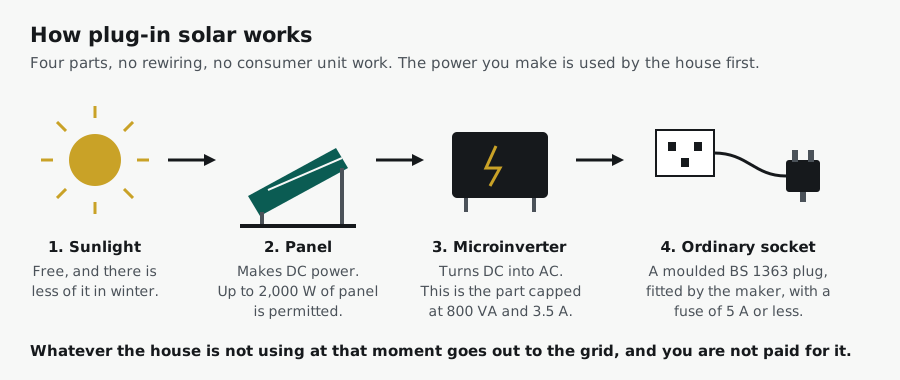
How plug-in solar works
Four parts. No rewiring and no consumer unit work.
The longer detail
Collapsed so the page stays readable. Open what you need.
7.1Getting the most out of it
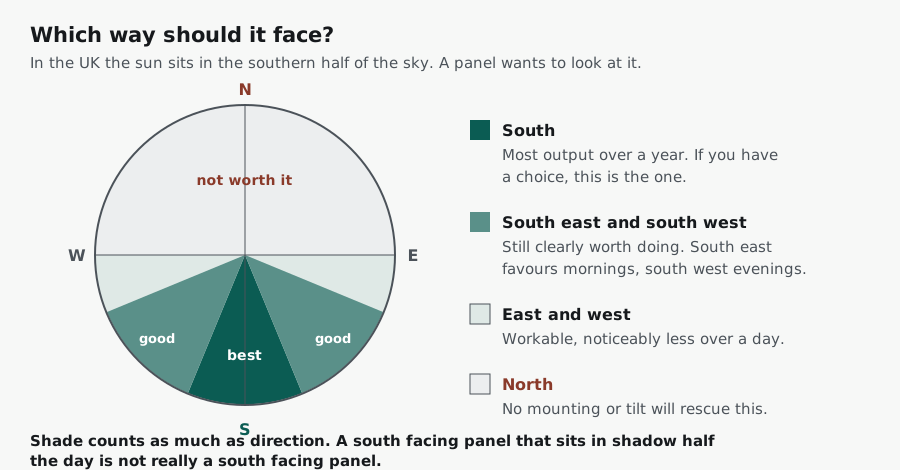
Face it south if you can. South gives the most output over a year. South east and south west are still worth doing. North facing is not, and no amount of good mounting will fix that.
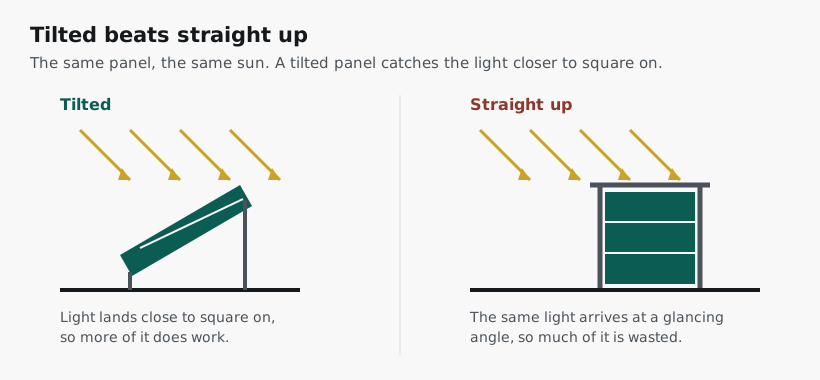
Tilt beats vertical. A panel hung flat against a railing, standing straight up, loses a large part of what a tilted one would produce.
Panels lose output when they get hot. A solar panel is rated at a cell temperature of 25C. As the cell gets hotter than that, output falls. This is about the temperature of the panel itself, not the weather.
You cannot add your own spacers or swap the brackets to create an air gap. Substituting anything in the mounting system is what voids the product approval. If airflow behind the panel matters to you, check the instructions before you buy.
7.2Getting the cable indoors
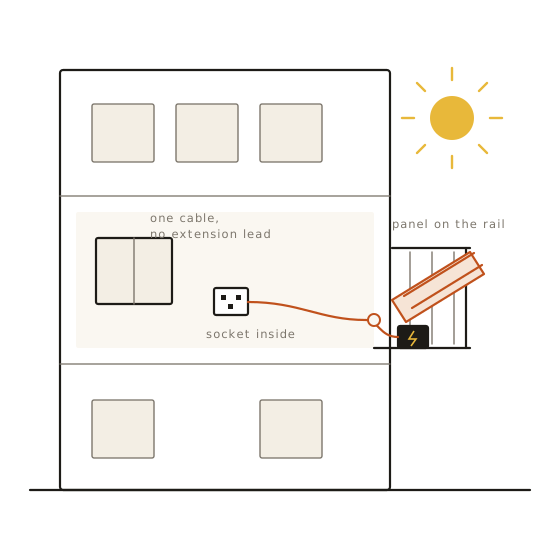
The cable has to reach a socket on its own, with no extension lead and no adaptor. For a garden or a balcony with a socket already outside, that is usually fine. For a panel on an outside wall, it often is not.
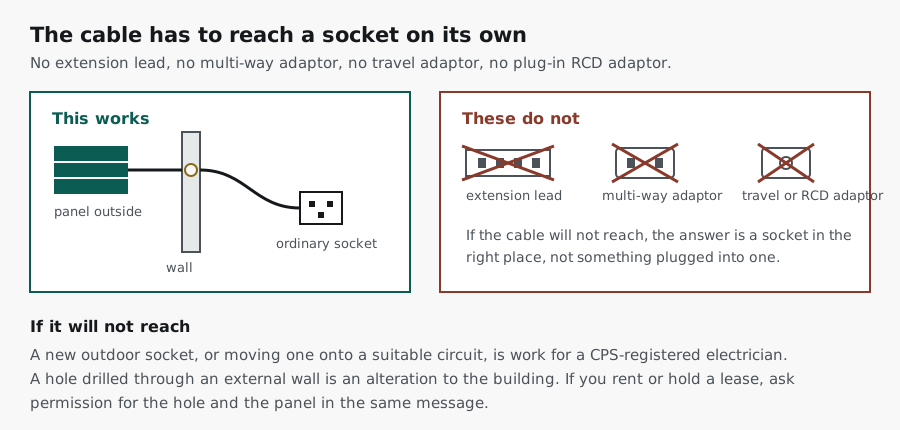
The two ways round it are a new outdoor socket, or a hole drilled through the wall. Both are electrical work on the fabric of the building. A new outdoor socket, or moving one onto a suitable circuit, is work for a CPS-registered electrician, not a handyman.
Drilling through an external wall is also an alteration to the building. If you rent, or you own a leasehold flat, that needs permission before anyone starts, and permission for the panel is not automatically permission for a hole. How to get approval.
7.3The fitting checklist
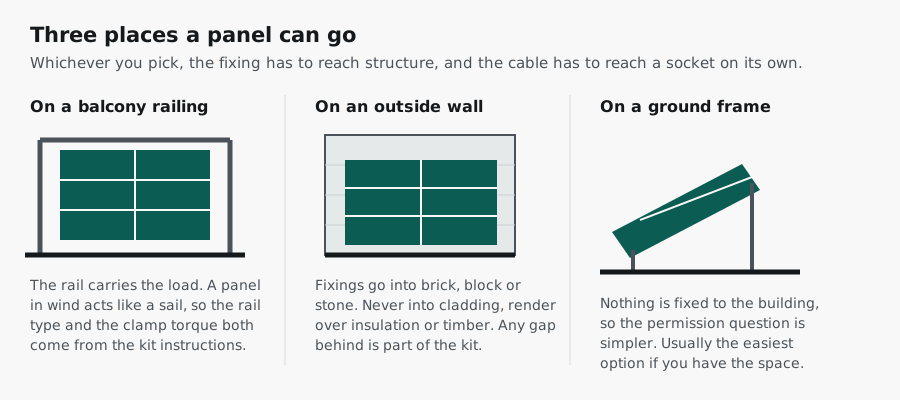
Use the mounting system supplied in the box, exactly as the instructions say. Do not substitute brackets, fixings or straps for something from a DIY shop.
Fixings must go into structure. Never into cladding, never into render over insulation, never into balcony timber or decking. If you cannot tell what is behind the surface, stop and ask.
The rail must take the load. A panel in wind acts like a sail. The rail type and the clamp torque both come from the kit instructions.
Wind and height limits are set by your kit, not by a national figure. The manufacturer has to state the maximum installation height above ground and any other restrictions.
The cable must not be crushed or block an escape route. Keep escape and rescue paths clear, and do not fix anything to a wall that forms a boundary between dwellings.
In a block of flats you need freeholder consent, and you must tell your insurer. Anything fixed to the outside of the building is an external alteration.
7.4The compliance rules in full
Power. The device must not supply more than 800 VA to the mains installation, and the current must not exceed 3.5 A.
Panels. Total panel DC output must not exceed 2,000 W. No more than four modules, no more than two in series, and no more than 120 V DC open circuit at the inverter. Above 960 W of panels the manufacturer must advise you to consider having your wiring assessed.
Plug. A non-rewireable moulded plug to BS 1363-1 with partially insulated pins and a BS 1362 fuse not exceeding 5 A. The socket must comply with BS 1363-2. The plug is fitted by the manufacturer.
Connection. Straight into the wall. Multi-way adaptors, travel adaptors, RCD adaptors and plug convertors are not permitted, and the plug must carry a warning against extension cables. The circuit must be a socket circuit, not a lighting circuit and not a spur feeding fixed equipment such as a cooker or boiler.
How many. One device per household. The specification is written per final ring circuit, but it records that G98 restricts this to one per household unless and until that is amended, so one per household is the rule that applies.
Buildings. Installation is not permitted on aluminium composite or metal composite cladding, high pressure laminate cladding, timber cladding, timber balconies, or buildings subject to external wall or building safety remediation works.
Permission. You are responsible for getting any permission needed from the property owner, landlord, freeholder, managing agent or relevant authority, and for any planning permission or Listed Building Consent. You are also responsible for checking whether the installation affects your insurance or the building’s.
Notification. Telling your distribution network operator about connection and disconnection is mandatory.
Product. Compliance attaches to the whole kit, not the inverter alone. The manufacturer must have the device type tested to G98, registered on the ENA Type Test Register, and confirmed as compliant before it is placed on the market. Being submitted to the register is not the same as being compliant on it.
Where this applies. The limb of the law that makes connecting lawful covers England, Wales and Scotland only. Northern Ireland is outside it.
Sources: SI 2026/848 as made, legislation.gov.uk. Plug-in Solar Device Interim Product Specification v2.0, clauses 1, 3.3, 4.1, 4.2.2, 5.8, 6.2.2, 6.2.3.1, 6.2.3.2, 7, 8.2.3.1, 8.3.1, 8.3.2, 8.3.3, 9.3, DESNZ.
7.5Before you buy: what is actually on sale
The rules allow a panel on a balcony rail or a wall. That does not mean a kit exists for it yet. The kits reaching UK shelves first are sold for ground mounting, and at least one carries a plain warning that it is not suitable for balconies and is for ground use only.
A kit may only be installed the way its own instructions allow. If you want a balcony mount, check the kit is sold for it before you buy, not after. What to check before you buy.